
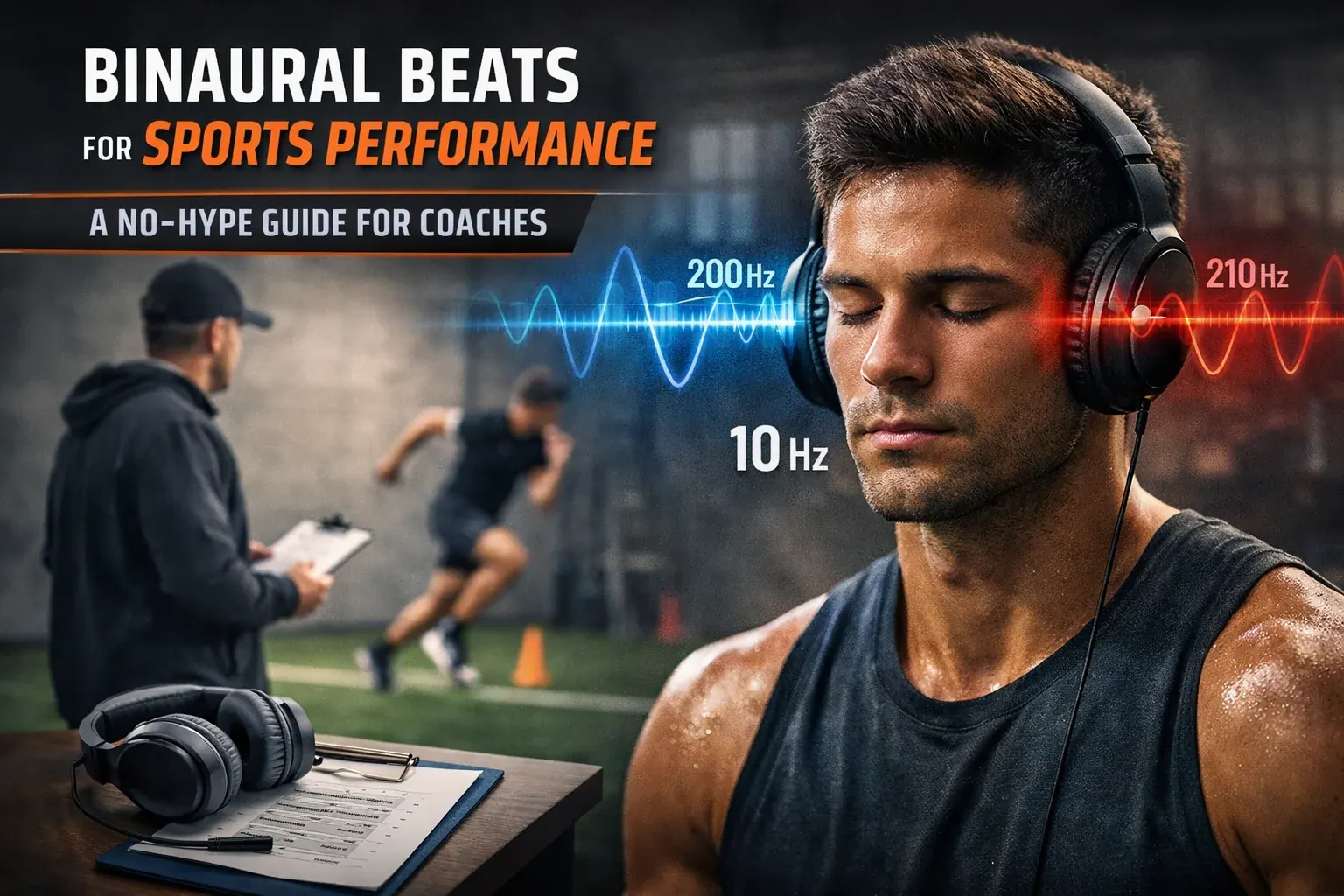
he “frequency” world is full of confident claims and thin evidence. If you hear “binaural beats” and your skepticism spikes, you’re doing it right.
Here’s the adult version: what they are, what they aren’t, and how to evaluate them like you’d evaluate any training tool—with a protocol, not a vibe.
No medical claims. No miracles. Just a practical experiment you can run next week.
What binaural beats are
Binaural beats happen when you play two slightly different tones, one in each ear.
Your brain perceives a third “beat” at the difference between them.
Example:
-
Left ear: 200 Hz
-
Right ear: 210 Hz
-
Perceived beat: 10 Hz
That’s the whole mechanism. It’s a stereo listening effect, not “hidden music” or secret code.
What binaural beats are NOT
1) Not a replacement for training
They won’t fix poor mechanics, lazy habits, or bad standards.
2) Not mind control
If someone promises “this frequency guarantees X,” treat it like a late-night infomercial.
3) Not universal
Some athletes feel a clear difference. Some feel nothing. Some hate it.
Your job isn’t to believe—it’s to test.
The real use-case: a consistent state cue
If binaural beats help at all, it’s usually here: they make a short routine easier to repeat.
Same sound → same timing → same breath pattern → same intention → more reliable “ready” state.
Think of it like a walk-up song for the nervous system—useful when it’s consistent, useless when it’s random.
Why headphone quality matters more than people admit
Binaural beats rely on clean left/right separation. If audio bleeds between ears or the environment is loud, the cue gets messy.
If you want a fair test, don’t run it through:
-
phone speakers
-
a locker-room Bluetooth speaker
-
one shared earbud
-
“whatever cheap earbuds they already have”
Simple team standard: pick one decent setup and keep it consistent.
Minimum headphone checklist (coach-friendly):
-
true stereo (obvious, but still)
-
good seal / isolation (closed-back or well-fitting in-ears)
-
low leakage (so left/right stays distinct)
-
comfortable for 5 minutes (compliance beats specs)
If you’re already using High Frequency Headphones, the main advantage is consistency across bus/locker room/hotel—same fit, same isolation, same cue.
The 7-day team experiment (clean, coachable, measurable)
Pick 8–12 athletes, one scenario, one track. Keep it boring on purpose.
Choose ONE scenario
-
Pre-practice lock-in (before warmup)
-
Post-practice downshift (after training)
-
Pre-game readiness (arrive → reset → focus)
Daily protocol (5 minutes, same time, same spot if possible)
-
Headphones on
-
One steady soundscape + subtle binaural layer (don’t track-hop)
-
3 breath cycles: inhale 4, exhale 6
-
One intention sentence (athlete chooses, keep it short)
Coach script (10 seconds):
“Same track. Same breathing. One sentence. Log it. That’s the whole deal.”
Athlete intention examples (pick one):
-
“Fast start, simple decisions.”
-
“Calm body, sharp eyes.”
-
“One play at a time.”
What to measure (don’t overengineer)
Log three numbers, daily:
-
Athlete-rated focus (1–10)
-
Athlete-rated calm (1–10)
-
Coach-rated start quality (1–5)
Baseline: if you can, record these for the week before you introduce the audio. If not, start Day 1 and be honest about it.
Decision rule (so you don’t talk yourself into it)
After 7 days, it’s a “yes” if you see:
-
higher average focus/calm and/or
-
better “start quality” (fewer early mistakes, cleaner first reps) and
-
athletes actually want to keep doing it
If it requires constant hype to get compliance, it’s not a tool—it’s a distraction.
Common mistakes that make it fail
-
switching tracks every day (“new is better” syndrome)
-
trying 20 settings in one session
-
turning it into a lecture or a ritual performance
-
waiting for a dramatic “moment”
This is a cue. The value is repetition, not intensity.
Scaling it without turning it into a gimmick
If it works for a subset of athletes:
-
keep it optional (forced = backlash)
-
standardize when it happens (timing beats novelty)
-
keep 2–3 tracks max for the whole program
-
protect the 5 minutes (no phones, no chatter, no coaching monologue)
Bottom line
Binaural beats are not a shortcut. They’re a repeatable switch some athletes can use to enter a useful state.
The win is the system:
-
consistent cue
-
consistent timing
-
consistent measurement
If you want to test a simple, coachable setup, High Frequency Highway is one option: